
You are moving funds on a decentralized exchange before work, comparing a quoted price with the amount you expect to receive. The interface looks familiar: connect a wallet, approve a token, confirm a swap. Yet the decisive event is not the button click. It is the set of instructions sent to a smart contract, the permissions attached to those instructions, and the state of several blockchains at the moment the transaction is executed. A transaction can therefore be valid, signed, and mined while still producing an outcome the user did not intend.
This is the central shift in DeFi. Wallets were once treated mainly as key storage and transaction broadcasters. Increasingly, they are becoming interpretation and risk-analysis layers between people and programmable financial systems. That change matters for US users navigating multiple EVM networks, unfamiliar dApps, token approvals, bridges, lending markets, and rapidly changing contract deployments.
From sending transactions to interpreting intent
Early Ethereum usage encouraged a simple mental model: an address sends an asset to another address. DeFi made that model inadequate. A single transaction may call a router, which calls a liquidity pool, which transfers tokens, updates accounting records, and invokes another contract. The user sees “swap,” but the blockchain processes a sequence of machine-readable operations.
A smart contract is code deployed on a blockchain. A DeFi protocol is usually a collection of such contracts that coordinate rules for trading, lending, borrowing, staking, or derivatives. A dApp, or decentralized application, is the user-facing software that helps people form and sign those interactions. These layers are related but not identical. The dApp may be compromised or poorly designed even when the underlying protocol is sound; a protocol may be audited yet still expose a risky function; and a wallet may accurately display a transaction without being able to guarantee the contract’s economic behavior.
The useful question is therefore not simply, “Is this dApp legitimate?” It is: “What will this exact transaction cause, under the current chain state, and what authority will I give the contract afterward?” That question separates identity-level trust from transaction-level analysis.
Why transaction simulation changes the decision
Transaction simulation attempts to execute a proposed transaction against a representation of current blockchain state before the user signs it. Depending on the implementation and network conditions, the resulting preview may reveal expected token transfers, approvals, balance changes, contract failures, or suspicious recipients. This is valuable because raw calldata—the encoded instructions sent to a contract—is not written for ordinary reading.
Simulation creates a practical bridge between code execution and human judgment. Instead of relying only on a dApp’s labels, the user can inspect consequences: which asset leaves the wallet, which asset arrives, whether an approval grants a narrow amount or effectively unlimited spending authority, and whether the transaction touches an unexpected contract.
There is an important limitation. A simulation is a conditional forecast, not a guarantee. The blockchain state can change between simulation and inclusion. A liquidity pool may move, a quote may expire, a contract may depend on block timestamp or transaction ordering, or a malicious contract may behave differently under certain conditions. Network-specific support can also vary. Simulation is best understood as a strong warning and comprehension tool, not an oracle of future truth.
This distinction is easy to miss. A green simulation does not mean an investment is safe, a token is valuable, or a protocol is solvent. It means that under the tested assumptions, the transaction produced an expected execution result. Economic risk remains separate from execution risk.
Approvals reveal the hidden persistence of DeFi access
One of the most consequential concepts in smart contract interaction is the token allowance. When a user approves a contract to spend an ERC-20 token, the permission can remain active after the immediate swap or deposit is complete. If the allowance is broader than necessary and the approved contract later becomes vulnerable or malicious, the permission may create a path to future loss.
This is why “I only signed one transaction” can be misleading. The first transaction may establish a durable capability rather than transfer funds immediately. A wallet that distinguishes an approval from a direct transfer helps users reason about persistence: what authority was granted, to whom, for which token, and for how much?
Limited approvals reduce exposure but can introduce friction and additional transactions. Unlimited approvals are convenient and may reduce repeated signing, yet they enlarge the consequences of a compromised spender. Neither choice is universally correct. A user interacting frequently with a well-understood protocol may accept a different operational trade-off from someone testing a new dApp with a large balance in the same wallet.
A reusable rule is to treat approvals as access-control decisions, not routine pop-ups. Review them separately from the financial strategy. Periodically revoke permissions that are no longer needed, while recognizing that revocation itself is an on-chain transaction with a network fee and may not address every form of contract risk.
dApp integration is a trust boundary, not a convenience feature
Wallet integration allows a dApp to request account access, identify a network, prepare transactions, and ask the user to sign them. That convenience can conceal a division of responsibility. The dApp chooses what to construct; the wallet controls the signing interface; the blockchain determines what executes. A failure in any layer can produce a harmful result.
For this reason, users should verify the network and contract context rather than relying on visual familiarity. A convincing interface can point to a look-alike contract. A legitimate protocol can deploy different contracts across chains. A token symbol can be copied. A transaction can also route through a contract that the user did not notice because the interface compressed several actions into one button.
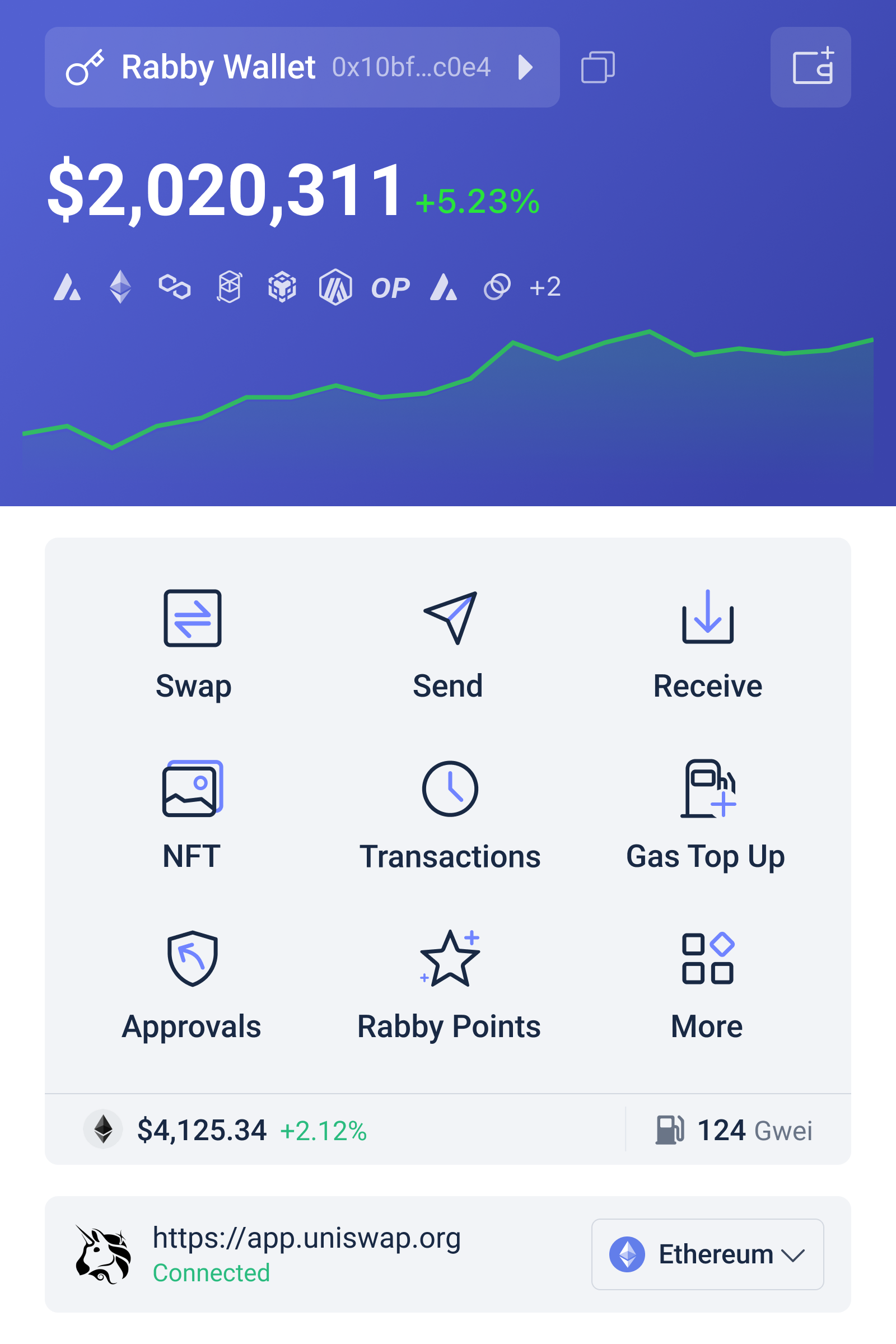
Advanced wallets such as rabby are useful in this environment when they make chain context, contract interaction, simulation results, and warnings more visible before signing. The value is not that a wallet eliminates judgment. Its value is that it can expose information at the moment when judgment is still possible.
That last point is more important than it sounds. Security warnings have diminishing value after confirmation. A warning placed beside the exact asset change or approval scope is more actionable than a general message that says users should “be careful.” Good interface design turns abstract security advice into a decision about a specific transaction.
A practical framework for reviewing a DeFi transaction
Before signing, examine the interaction in four passes. First, identify the action: swap, supply, borrow, withdraw, bridge, stake, or approval. Second, identify the authority granted: is the contract receiving tokens, permission to spend them, or control over another position? Third, inspect expected outputs and recipients. Fourth, ask what remains true after the transaction finishes.
The fourth question catches risks that a one-screen preview may not. A deposit may create a receipt token with its own risks. A borrow may introduce liquidation exposure. A bridge may leave assets dependent on a separate messaging system. A staking transaction may create an unlocking delay. A successful call can therefore be operationally dangerous without being technically anomalous.
It is also useful to separate three categories of risk:
- Execution risk: the transaction fails, uses unfavorable conditions, or affects an unexpected asset.
- Permission risk: an approval or authorization remains available to a contract longer or more broadly than intended.
- Protocol risk: the underlying code, economic design, oracle assumptions, governance, or dependencies fail.
Simulation primarily helps with the first category and can illuminate the second. It cannot, by itself, resolve the third. This boundary prevents a common mistake: treating a readable transaction preview as a substitute for evaluating the protocol’s design and incentives.
What has changed in the current DeFi wallet
The history of DeFi interfaces is partly a history of abstraction. Early users inspected addresses and function calls directly. Later interfaces made actions easier but often hid the composability that made them powerful. The current direction is a return of detail in a more usable form: wallets increasingly attempt to translate contract behavior into asset movements, permissions, warnings, and likely outcomes.
Recent positioning around Ethereum and EVM support reflects the practical reality that users no longer operate on one chain alone. EVM compatibility makes contract patterns portable, but it does not make every deployment identical. Liquidity, fees, contract versions, bridge assumptions, and token behavior can differ by network. “Same dApp” does not necessarily mean “same risk profile.”
The likely next step, if the technical and interface challenges are solved, is more context-sensitive signing. Wallets could present different levels of scrutiny depending on transaction size, contract history, approval scope, and whether the interaction is familiar or novel. That development would be useful, but it raises a design question: how much automation should a wallet provide before users stop understanding what they are authorizing? The best systems will probably need both fast paths for routine actions and deliberate review for unusual ones.
FAQ
Does transaction simulation guarantee that a DeFi transaction is safe?
No. Simulation can show how a transaction is expected to execute under particular assumptions, but blockchain state can change before inclusion. It also cannot establish that a protocol is solvent, that a token has value, or that a contract will behave safely in every future interaction.
Why should I care about token approvals if I am only making one swap?
An approval may give a contract continuing permission to spend a token. The swap may be completed, but the permission can remain. Review the approved spender and amount, prefer narrower permissions when practical, and revoke unused allowances while remembering that revocation requires another on-chain transaction.
Can a wallet protect me from a malicious DeFi protocol?
A wallet can improve visibility, flag suspicious patterns, and help users understand proposed effects. It cannot replace protocol research or eliminate smart contract, oracle, governance, liquidity, and market risks. Wallet security is one layer in a broader risk-control process.
The most durable lesson is simple but not simplistic: signing is not the same as understanding. Smart contract interaction sits between human intent and deterministic execution, and the gap between those two is where many DeFi losses begin. A capable wallet narrows that gap by showing consequences, permissions, and chain context before authorization. The user still makes the final decision, but better information changes the quality of that decision—and, in a composable financial system, that is a meaningful security improvement.